About:
Exploring new approaches to machine hosted
neural-network simulation, and the science
behind them.
Netlab Loligo on Facebook
Your moderator:
John Repici
A programmer who is obsessed with giving experimenters
a better environment for developing biologically-guided
neural network designs. Author of
an introductory book on the subject titled:
"Netlab Loligo: New Approaches to Neural Network
Simulation". BOOK REVIEWERS ARE NEEDED!
Can you help?
Other Blogs/Sites:
Neural Networks
Hardware (Robotics, etc.)
|
Friday, March 2. 2012
The site was switched to a new hosting service at the end of February. The blog and glossary were the pieces I was most anxious about, but they seem to have handled the move just fine.
So far, this host seems to be providing much faster responses. It should also provide better up-time.
Responses have gone from often taking 40-70 seconds, down to less than ten seconds. In fact, I haven't counted a single response greater than 12 yet.
The previous provider would regularly (about once a month) make changes that completely hid most, or all, of the site's content from the search-engines and in-links. Those down-times would typically last from two to six days. Many down-times, including the last one, only ended when I wrote some defensive code to work around their new server-settings.
Hoping this provider will do better in that department as well.
So far, I'm happy with it.
P.S. — BTW, I'm also new to something called TraceWatch, which is a stats package. So far, I'm totally addicted to it. It's like FarmVille for webmasters.
Thursday, January 19. 2012
Spent some time today doing minor edits to glossary entries. Of all the small edits, the most significant change made was to add the following section to the entry for weights.
“ . . . . . . .
Netlab's Compatibility Mode
ANN models that use floating point signed-value weights in the conventional fashion are math-centric. That is, they typically are concerned only with the signed numeric weight-value, rather than with the connection-strength represented by its absolute value. In this case, for example, increasing the weight value will make it more positive, regardless of whether it is representing an excitatory or inhibitory connection.
Netlab's default behavior is to operate directly on connection-strength representations, regardless of how they are implemented internally. Netlab neurons facilitate the conventional practice, however, by allowing it to be specified in the learning method for each weight-layer.
The table below shows how Netlab facilitates compatibility with existing practices. The table documents how the translation is carried out between the traditional math-centric convention, and Netlab's connection-strength-centric convention.
Connection-Type->
v--Operation
|
Excitatory
|
Inhibitory
|
|
Increase
|
Increase Connection Strength
|
Decrease Connection Strength
|
|
Decrease
|
Decrease Connection Strength
|
Increase Connection Strength
|
Translations performed when conventional adjustment practice is specified for a connection.
”
One possible analogy for the conventional, value-based, adjustment practice is that of adjusting for a specific water temperature from a faucet. If the water is too cold, for example, adjusting the weight value is comparable to simultaneously increasing the hot and reducing the cold (hot being the negative inhibitory weights, and cold being the positive excitatory weights in this analogy). Conversely, if the water is too hot, it is adjusted by simultaneously decreasing the hot, and increasing the cold.
In this way, Netlab is able to fully support the practice of working directly with the numeric value of a signed weight, but it also supports its own alternative strategy of adjusting connection strength representations. This strategy seems to be more representative of what has been learned about the cell, and molecular biology of neurons. The faucet analogy used above to describe the value-based adjustment is not sufficient to describe this strategy [1].
- Related glossary entries:
===========
Notes:
[1] - This is not to say the connection-strength adjustment strategy can't be related with an analogy, just that I have been too lazy, or too unfocused to come up with one that feels satisfyingly apt.
Monday, November 14. 2011
The Glossary entry for William of Ockham here at the site has a new section titled “ In Other Words?”. This new section attempts to provide a nutshell explanation of William's original advice more accurately than the nutshell statement commonly used today. The advice in question is commonly referred to as Ockham's Razor. Here's the suggested new nutshell definition from the glossary entry.
"Always express things using the most general representation possible for the context in which the representation is being used."
The glossary entry goes on to clarify that this is just an attempted improvement over the current vague fashion statement, and it welcomes other suggestions.
-djr
Monday, May 9. 2011
Hi,
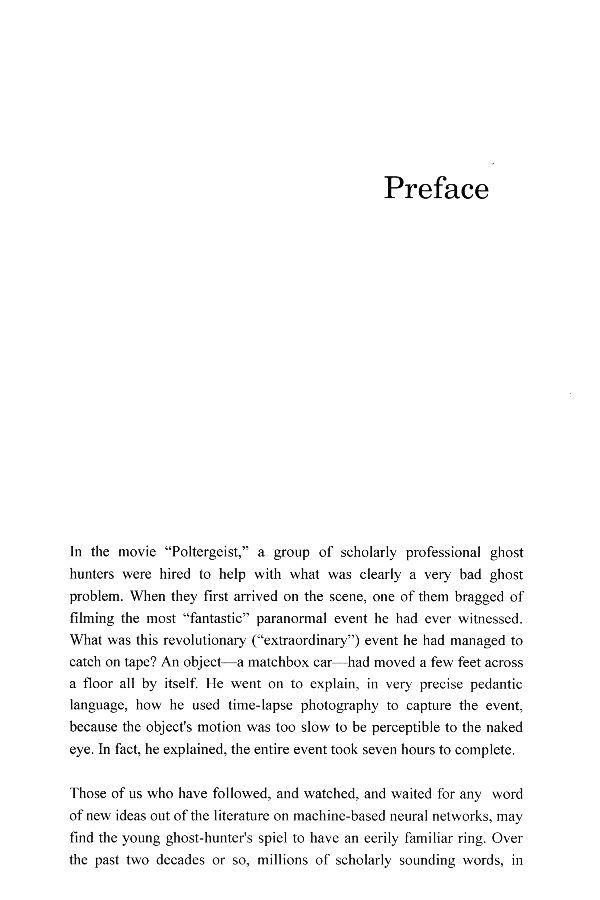
The Preface of the book has now been added to the Excerpts Pages that are available here at the site. -djr
|
|
Thursday, December 10. 2009
It's finally possible to perform a reasoned analysis
Now that the design decisions are no longer clouded in concerns about browser capabilities, it was finally possible to attempt a CSS layout (CSS-P), and consider it critically as a design option. Have a look at the glossary page, for what's left of that experiment (though it may be partly or totally converted to tables by the time you read this).
Here's what I've learned: CSS Layout doesn't work for producing re-sizable, hardware-independent web-page layouts..
- It isn't the fault of the browser manufacturers,
- It isn't the fault of the stupid, dinosaur, uninformed, unskilled, [pick from the many other aspersions the CSS-layout promoters cast] page designer,
- It isn't Microsoft's fault.
The problem? The CSS standard itself.
[Read more...]
Thursday, December 10. 2009
This was originally on the early front page. I've moved it here now that there's a blog for this sort of thing
For now a to-do list for web-tasks:
- Make a crude logo image.[done]
- Create a favico for the site.[done]
- Create a top-image logo for site.[done (rough draft)]
- Link to here from the "old" NN page at
my personal site.[done]
- Experiment with unrestricted dynamic facilities
(e.g., run ShowEnv2.pl)[done]
- Point StandOutPub.com/net/org to here for
now.[done]
- Make a general contact e-mail address for
StandOutPublishing.com[done]
- Set up SOP accounts in mail clients.[done]
- Make a contact form for StandOutPublishing.com[done]
- Experiment with STATIC limited-access areas for just
me (for now)[done]
- Site development area[started]
- Page template, Base[started]
- Page template, Book
- Area templates, ContentGeneral, ContentBook[started]
- To-do list w/links to project areas.
- Specification pages (Project areas)
- Experiment with available captchas and select one
- Experiment with available blogs and select one[done]
- Experiment with shopping carts for book sales
- Experiment with ways to get customer feedback on book-page
- Experiment with DYNAMIC limited-access area for just me
(for now) [done]
- Start working on "about" page(s).
- Set up book page and resources in restricted area (until
ready).
- Bring over NN Glossary from Creativyst.com[done]
- . . . Scrub NN glossary so that it can be linked without restriction[done]
- . . . Un-restrict and link scrubbed glossary in temporary menu (for now)[done]
- Install QuoteCatcher, add a cateogry for Netlab quotes[done]
- Start a pile of links (video links first)[started]
- Install QC database(s) for testimonials (good and bad).
- Install QC (or maybe blog) for book reviews (needs captcha)
- Set up News Entry Widget...
- ...Or, look into Blog software[done]
- List RSS on News
- Set up Netlab area
- Set up Netlab History page
- Move content/links to here from "old" network page
at personal site
Thursday, December 10. 2009
Yay! The site now has a blog.... That is one more thing to scratch off the to-do list (which will now be maintained here on the blog  )
Next up, the shopping cart application...
|
|