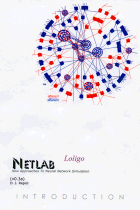
Netlab Loligo, New Approaches To Neural Network Simulation (v0.3a) - Book information page.


Netlab Loligo (v0.3a)
New Approaches to Neural Network Simulation
 
Dominic John Repici (Author)


Price: $38.95
        Introductory price (regularly $47.95)


In Stock! Shipping.
        Free shipping in U.S.


Free Shipping to U.S.

Price: $38.95

Paperback: 352 pages

Publisher: Stand Out Publishing

Language: English

ISBN: 978-0984425600

Dimensions: 6 x 9 x 0.68 inches

Shipping Weight: 1.25 lbs

Also At:     Amazon.com   


Product
Description:


The building blocks of the universe are, well... building blocks.
 
This book introduces and describes Netlab Loligo, a neural network development environment that enables highly complex, and highly scalable network designs. The Netlab development and runtime environment was born out of a desire to create biologically inspired neural network structures of much greater complexity, and variety than has been traditionally supported in formulaic ANN models. Netlab is not a formulaic, math-centric environment.

The Netlab environment described by this book provides a set of novel approaches and methods for designing and developing neural networks. For example, among the methods introduced, are two new (patent pending) learning methods:   1.) "weight-to-weight learning" which enables short- and long-term memory to be modeled more correctly, and   2.) “influence learning”, which allows unlimited layering, and completely eliminates restrictions on feedback. Taken together, the various methods discussed in this book will enable the construction of neural networks that more closely resemble the capabilities and structures of biological neural networks.

A new neural network description language, called Noodle™, is also introduced and described. It gives experimenters the tools and power needed to conquer much of the complexity and nuance required of biologically inspired neural network designs. The development metaphor of this language is simply that of electronic device development. Specifically, you build devices (called units) and maintain an inventory of different devices. You then connect those devices together as components in more complex designs, which you also maintain as components to be used in the same way.


Five
Selected
Sentences:  


[D]


Related
Publications:


These are related works (from other publishers), which are available on the Internet, or sold at Amazon.com. For now, these will include the books and papers that have been cited in this book's references section.
 
  The Neuron: Cell and Molecular Biology - Listed as the primary reference in the book.


  Thinking in Pictures, Expanded Edition: My Life with Autism - Listed as a reference regarding thinking, and consciousness in the book's reference chapter.


  Conditioned Reflexes - Listed as a reference in the book. Translation of Pavlov's lectures on his classical conditioning work.


  The Conscious Mind: In Search of a Fundamental Theory (Philosophy of Mind Series) - David Chalmers is listed as a reference in the book. His writings, and writings he has accumulated at http://consc.net/chalmers/ are listed as a source for good reading on matters of the philosophy of mind and consciousness.


  [pdf] A Theory of Cerebellar Cortex - David Marr - Listed as a referrence in the book. Available to download free. From the abstract:
"A detailed theory of cerebellar cortex is proposed whose consequence is that the cerebellum learns to perform motor skills. Two forms of inputoutput relation are described, both consistent with the cortical theory. One is suitable for learning movements (actions), and the other for learning to maintain posture and balance (maintenance reflexes)."


  In Search of Schrödinger's Cat: Quantum Physics and Reality - Listed as a reference.
“Everybody knows that the greatest discovery of the 20th century was Einstein's Theory of Relativity, and EVERYBODY is wrong.”


Keys
Subjects
Categories:

 
Tags/Key-words:
  • adaptive systems
  • artificial intelligence
  • brain
  • cognitive psychology
  • cognitive science
  • cognition
  • computer
  • consciousness
  • electronics
  • learning
  • machine consciousness
  • machine learning
  • memory
  • mind
  • neural networks
  • neuron
  • neuroscience
  • perception
  • programming
  • philosophy of mind
  • psychology
  • robotics
  • thought
Subjects
  • Artificial Intelligence
  • Brain
  • Cognition & cognitive psychology
  • Cognitive Psychology
  • Computers
  • Computers - Languages / Programming
  • Connectionism
  • Mental Processes
  • Neurons
  • Neuroplasticity
  • Neuroscience
  • Philosophy of mind
  • Robotics
  • Technology & Engineering
  • Technology & Engineering / Robotics


BISAC Subject Headings: (bisg)
  • COM044000    COMPUTERS / Neural Networks
  • COM072000    COMPUTERS / Computer Simulation
  • COM017000    COMPUTERS / Cybernetics
  • COM051220    COMPUTERS / Programming / Parallel
  • PSY024000    PSYCHOLOGY / Physiological Psychology
  • PSY008000    PSYCHOLOGY / Cognitive Psychology
  • PSY020000    PSYCHOLOGY / Neuropsychology
  • TEC037000    TECHNOLOGY & ENGINEERING / Robotics


Misc.
Descriptions

 
  • Introduces a new theory of learning that embodies, and predicts the neurobiological experience/perception of a “present moment”. Patent pending methods and mechanisms are included within the described simulation environment, which fully model the theory.